• GoFundMe logo
  • GivingTuesday logo

Gen Z is more generous than you think

How a network-driven generation is redefining giving

Collage of gen z people
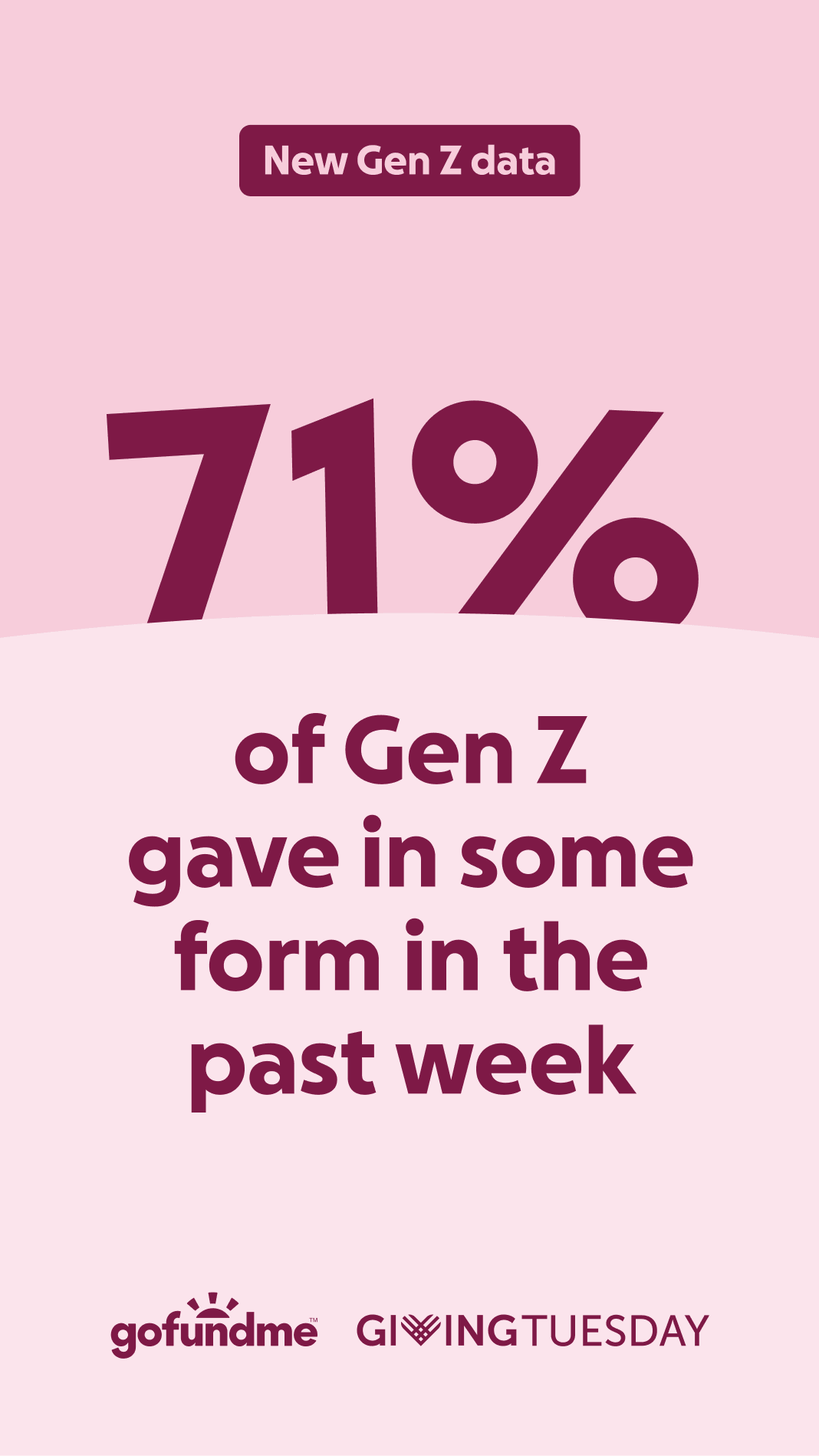
71%

of Gen Z gave in some form in the past week

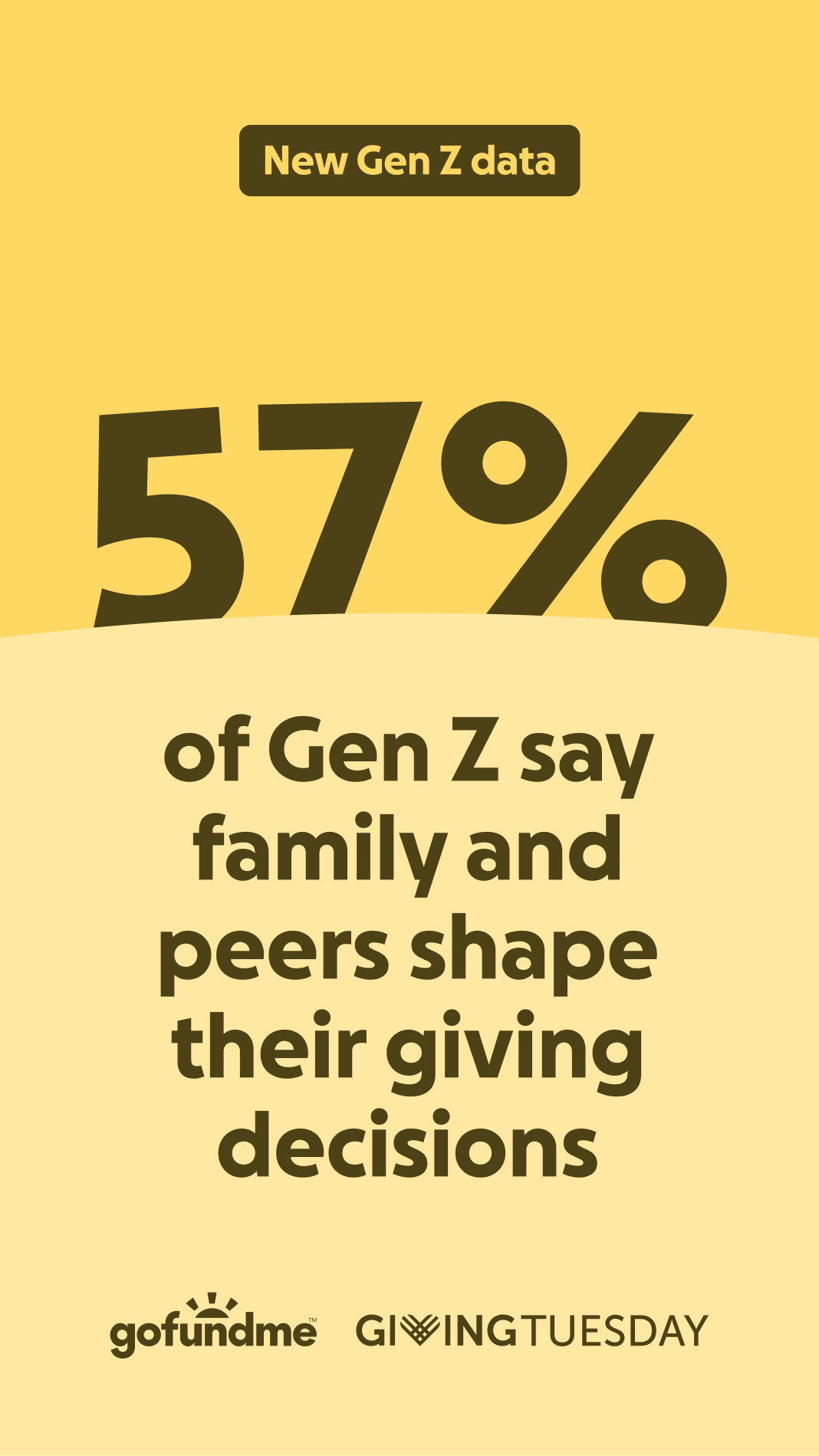
57%

say family or peers shape their giving decisions

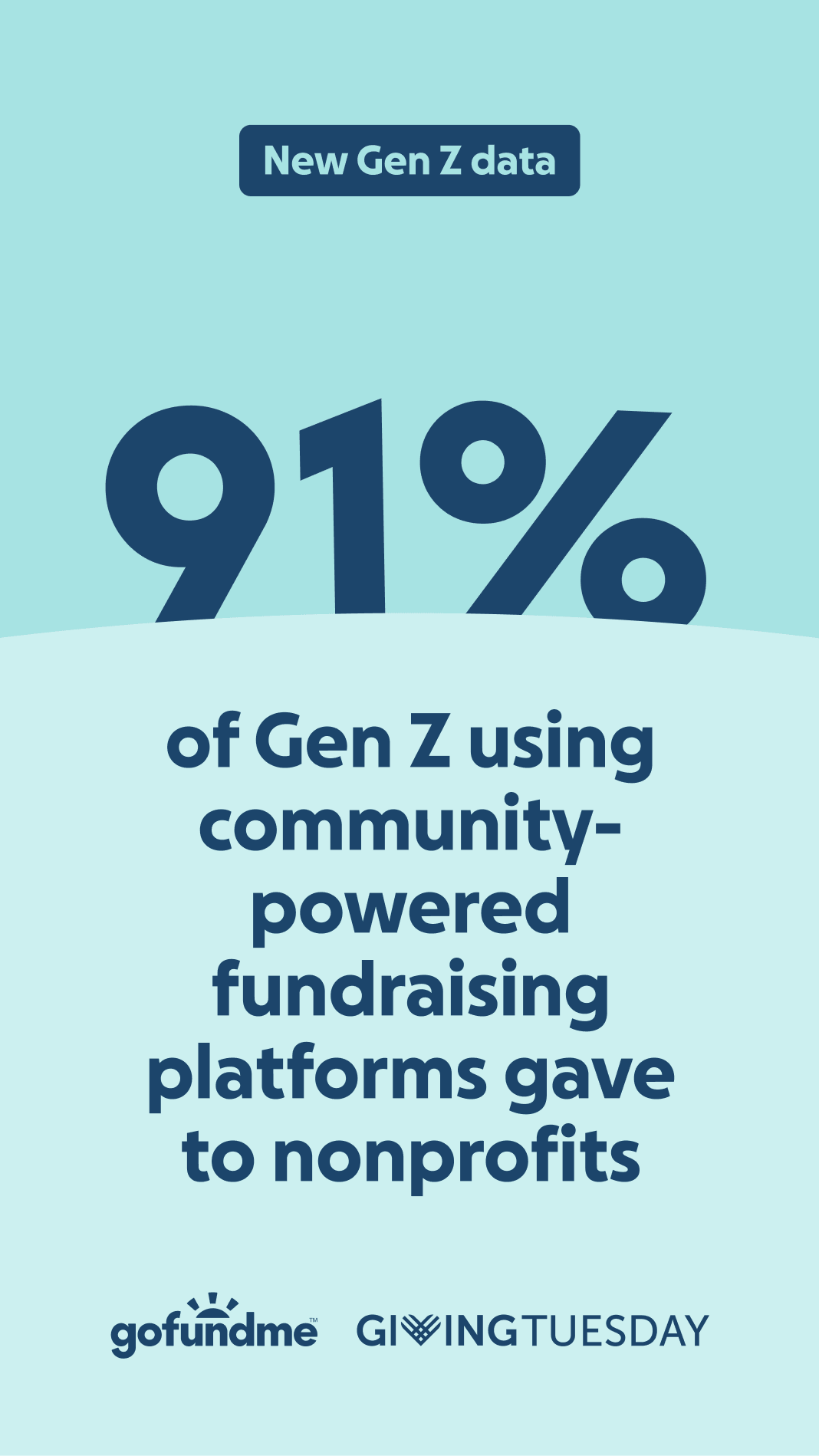
91%

of crowdfunding users gave to nonprofits

Overview

There’s a persistent narrative that Gen Z cares loudly but gives sparingly, that their public advocacy doesn’t translate into real impact, and that their generosity has shifted away from nonprofit organizations.

The data tells a different story.

This report, developed in partnership with GivingTuesday, explores how Gen Z adults (aged 18–29) express generosity today and how nonprofits can capture and sustain that participation, guiding supporters from awareness to sharing, from sharing to mobilization, and from mobilization to giving.

Top takeaways from this data

1

Gen Z gives in more ways, and more often, than other adults.

About 71% of Gen Z reported some form of giving in the past week, as compared with 65% of other adults. They were also more likely to give money (43% versus 39%) despite being more likely to have lower incomes, be students, or be unemployed, given their life stage.

2

This generation’s giving is distinctly personal and relational.

Gen Z stands furthest ahead of other adults in advocacy (+13 percentage points), giving directly to individuals (+12 percentage points), informal giving (+11 percentage points), and volunteering (+10 percentage points). They give where the need feels immediate and human.

3

Their trust is increasingly built through immediate networks.

About 57% of Gen Z supporters say family or others shape their giving decisions, compared with 43% of other adults. Community fundraising is uniquely positioned to meet this moment, serving as a natural entry point into giving and a key pathway to nonprofit engagement.

4

Sharing is a force multiplier for generosity.

Gen Z is 8 percentage points more likely to publicly support and advocate for community groups, nonprofits, and independent efforts. By making their support visible, they not only inspire others to see, join, and amplify that giving, but also help increase funds raised.

5

Same intent. New environment.

Young people have always been passionate, vocal, and driven by causes. What’s changed isn’t the desire to make an impact, but where that impact takes shape. For Gen Z, that environment is digital. And in the right digital spaces, intent translates into action.

6

Crowdfunding is an on-ramp to nonprofit giving.

About 91% of Gen Z crowdfunding users gave to registered nonprofits—16 percentage points higher than their peers who don’t use crowdfunding platforms. They also report less financial strain and increased ability to give more. In other words, network-driven giving expands the generosity funnel instead of fragmenting it.

GivingTuesday logo
Terms we use throughout the report:

Gen Z

Respondents aged 18–29 

Other adults

Respondents aged 30–85

Boomers

Adults aged 59+

Formal giving

Giving money, time, or items in support of a registered nonprofit 

Informal giving

Giving money, time, or items in support of an organized or structured community group, association, or club that isn’t a registered nonprofit. This may include local fundraising efforts, giving circles, or mutual aid networks.

Registered organization

A 501(c)(3) tax-exempt nonprofit organization

Unregistered organization

An organized or structured community group, association, or club that isn’t a registered nonprofit. This may include local fundraising efforts, giving circles, mutual aid networks, GoFundMes (not for nonprofits), and similar organized activities.

Advocacy

Recommending, encouraging, endorsing, or publicly supporting a recipient’s (a registered organization, unregistered group, or individual) activities

Chapter 1

Higher participation, even under constraints

When asked if they had given in the past week, Gen Z respondents were more likely than other adults to say yes. About 71% had participated in some form of giving, compared to 65% of adults between ages 30–85, and their participation spans far more than a single behavior. 

They lead in participation across every modality measured in GivingPulse, including giving to registered and unregistered organizations, informal giving, donating items and money, as well as volunteering, advocacy, and direct support to individuals.

Types of giving:
Gen Z vs. other adults

Difference across age groups in giving patterns

Gen Z (Aged 18–29)
Other adults (Aged 30–85)

Gave in any form

70.8%
65.2%

Gave money

42.7%
38.8%

Donated items

45.3%
40.5%

Volunteered

35.2%
25.2%

Advocated for a cause

32%
18.8%

Other giving

42%
31.6%

Gave to a registered org

48.1%
45.4%

Gave to an unregistered org

45.5%
35.1%

Gave to an individual

47.3%
35.7%

Informal giving

57.8%
47.3%

This pattern is especially notable given their financial reality.

Compared to other adults, a considerably higher share of Gen Z respondents fall into lower income brackets (68% versus 50%, +18 percentage points), are students (+13 percentage points), and are unemployed (+9 percentage points).  

Income breakdown

Gen Z (Aged 18–29)
Other adults (Aged 30–85)
68% 50%

Less than $75k

20% 31%

Between $75k–$150k

4% 15%

Over $150k

By traditional assumptions, this would point to lower participation. Instead, we see the opposite.

Nearly 43% of Gen Z reported donating money in the past week (roughly 4 percentage points higher than other adults).

While participation is higher, total dollar contributions are lower. This isn’t a contradiction, but likely a reflection of life stage: Traditional philanthropy has long been an age-onset behavior, with financial contributions often increasing alongside income and stability. 

This makes it especially important to look beyond immediate dollars alone.

Gen Z is significantly more likely to share and amplify causes within their networks, extending the reach of both an organization’s mission and every donation.

Their giving often includes recruiting others, making them not just donors but amplifiers of generosity. 

That multiplier effect is measurable: fundraisers shared within the first day raise 10% more on average,* and each organizer share drives an average of $100 toward the goal, according to GoFundMe research.

This behavior is both intentional and frequent. According to GoFundMe’s Social State of Giving report, 46% of Gen Z believes sharing donations helps spread the word and inspire others, and half shares causes or fundraisers at least weekly.

Gen Z isn’t just giving. They drive others to give, too.

* GoFundMe internal platform data

Chapter 2

Rooted in relationships

Looking more closely at how Gen Z participates in giving, the largest generational gaps emerge in relational behaviors: They’re more likely to support individuals directly, volunteer, participate in advocacy, and engage in informal giving. These forms of generosity are immediate, personal, and often shaped by moments of need, relevance, or connection.

Types of relational giving:
Gen Z vs. other adults

Gen Z (Aged 18–29)
Other adults (Aged 30–85)

Volunteered

35.2%
25.2%

Advocated for a cause

32%
18.8%

Gave to an individual

47.3%
35.7%

Informal giving

57.8%
47.3%
Giving shaped by trust, social influence, and lived experience

This shift reflects a broader change in how trust is formed.

Gen Z is growing into their giving power in a landscape where trust is no longer granted institutionally, but transferred socially. With institutional trust more fragile and peer trust stronger than ever, we see that shift reflected in their giving, which often flows toward people, stories, and causes that feel close and tangible.

Attitudinal data reinforces this picture: Gen Z respondents were 14 percentage points more likely to agree that peer influence and family input shape their giving, suggesting that generosity isn’t just a personal decision, but socially learned, reinforced, and expressed.

Peer-to-peer is built for this shift, but not in its current form

Peer-to-peer fundraising is uniquely positioned to meet this moment, offering a distinct advantage: trust transferred through personal relationships. When supporters fundraise on an organization’s behalf, they lend their credibility, voice, and community to the cause.

Just not in the way it’s traditionally been defined or executed.

While the volume of peer-to-peer campaigns grew 18% in 2024, following pandemic-era declines, dollars raised per participant fell by 20%, revealing a widening gap between participation and performance. 

This isn’t just an execution issue. It reflects a deeper mismatch between how peer-to-peer fundraising has been designed and how people engage today. Participation is more frequent, more social, and less tied to specific moments or campaigns.

When peer-to-peer is confined to time-bound events or rigid campaign structures, it limits the behaviors that drive participation. The result is more people showing up, but fewer pathways to translate that engagement into meaningful outcomes.

👍

My giving choices are shaped by input from family and others.

57% of Gen Z
agree

vs. 43% of other adults

Community fundraising is where Gen Z giving begins

To close this gap, the model itself must evolve. Peer-to-peer fundraising must reflect how today’s supporters engage, enabling always-on, relationship-driven participation.

Community fundraising represents this next evolution, where participation is continuous, personal, and network-driven. It isn’t just a natural entry point. It’s increasingly where Gen Z giving begins.

Organizations need to rethink where time, budget, and attention are focused, shifting beyond tightly controlled frameworks to more open, supporter-led approaches. In this model, supporters can share their stories, mobilize their networks, and raise funds in ways that feel personal and relevant.

Community fundraising doesn’t replace traditional peer-to-peer events and campaigns. It builds on them. Grounded in trusted relationships and lived experiences, this approach is more authentic, more participatory, and more aligned with how giving happens today. 

The nonprofit provides the framework, but the supporter drives the action, creating space for continuous participation, shared advocacy, and deeper connection.

Young people laughing and looking at smartphone together Young people laughing and looking at smartphone together
Chapter 3

Visible and digital by design

While younger generations have long been perceived as less generous, that view may be especially pronounced for Gen Z. This isn’t because the desire to make an impact has diminished, but because the environment in which that impact takes shape has changed.


For Gen Z, that environment is largely digital, shaped by spaces where impact requires active participation to be visible and understood.

Community, identity, activism, and giving are no longer separate or primarily physical, but networked, immediate, and online.

As a result, generosity isn’t just an action. It’s a signal, often expressed publicly on social media, through shared campaigns, or within community spaces where others can see and respond.

In this context, visibility becomes validation. Participation builds credibility, reinforces identity, and invites others to engage. Causes gain momentum through social proof as people see who is giving, sharing, and showing up.

Giving is amplified through visibility

As giving becomes more social, it also becomes more participatory. Each act of generosity increases the likelihood of another, creating a network effect that can scale quickly across communities.

GivingTuesday’s GivingPulse survey found that Gen Z is 8 percentage points more likely than other adults to recommend, encourage, endorse, advocate for, or publicly share the activities of a community group, registered nonprofit, or independent effort to help others.

This gap is especially pronounced when you compare Gen Z to Boomers: Gen Z supporters are 10 times more likely than Boomers to share their donations on social media. 

By mobilizing their communities, Gen Z acts as a powerful amplifier, bringing more donors into the fold. Within this broader shift toward trust in peer networks, their role is increasingly critical to nonprofits’ health and continued relevance.

Public endorsement by cause type:
Gen Z vs. other adults

Gen Z (Aged 18–29)
Other adults (Aged 30–85)

An independent effort to help others

16%
8%

A community group

18%
13%

A registered nonprofit

20%
12%
Digital environments reinforce intent

Digital spaces don’t just prompt action. They capture and reinforce intent. Gen Z respondents who planned their giving in advance were more likely to report being reached via digital giving prompts (+13.2 percentage points on social media and +6.4 percentage points online via websites) as compared to spontaneous givers in the same age group.

This suggests that digital environments—especially social media channels—play a dual role: They surface giving opportunities while also helping individuals act on motivations they already hold.

Solicitation channels among Gen Z givers

Pre-planner
Spontaneous
12.3% 5.9%

Online via website

31.8% 18.6%

Social media (Organic)

In this environment, fundraising is no longer confined to controlled spaces, like direct mail or formal campaigns. Instead, it unfolds across decentralized, networked systems where visibility, timing, and social context shape participation and scale.

Reaching Gen Z within this landscape requires more than adapting traditional approaches. It means showing up where these behaviors already happen and understanding how they take hold and spread. This level of engagement depends on platforms and partners that are deeply embedded in these ecosystems, with a clear understanding of how generosity is expressed, amplified, and sustained, and how these behaviors are continuously shaped through design and interaction.


Chapter 4

Crowdfunding as a bridge

Understanding that Gen Z’s generosity spans multiple forms, it’s important to consider how nonprofits remain part of that ecosystem. The data suggests that crowdfunding plays a critical role in connecting these different modes of participation.

Connecting giving across channels

Findings from this dataset show no evidence that crowdfunding diverts support away from nonprofits, but instead helps expand participation in charitable giving.

91% of Gen Z individuals who give via crowdfunding platforms gave to registered nonprofit organizations

+16 percentage points more likely than those who give but don’t use crowdfunding platforms

💙

Gen Z crowdfunding users also show stronger underlying giving orientations. They’re 9.4 percentage points more likely to trust nonprofits and 8.1 percentage points more likely to have been raised with giving as a value, suggesting these platforms may be attracting individuals already predisposed toward broader generosity.

At the same time, Gen Z crowdfunding users show signs of greater financial capacity and intent. They report lower levels of financial strain (48.8% versus 57.5%) and are more likely to say they could afford to give more (65% versus 51.8%) compared to nonusers.

Together, this data underscores an important reality: Crowdfunding isn’t fragmenting the giving landscape, but instead reshaping how people enter and move through it.

It enables individuals to respond to immediate, relational needs—supporting a person, family, or local cause—while increasing their likelihood of engaging with nonprofits. 

Far from competing with traditional giving, it serves as an entry point and an amplifier, bringing more people into the broader ecosystem of generosity.

For nonprofits, the opportunity isn’t to compete with crowdfunding, but to connect to it, meeting donors where they are and building pathways to habitual support for their cause.

Young people looking down at camera Young people looking down at camera
Chapter 5

Growing Gen Z’s immediate impact and value over time

While Gen Z’s early participation across many forms of generosity signals strong potential for sustained support over time, organizations can’t assume it’ll automatically translate into increased monetary giving as financial capacity grows. At the same time, pushing Gen Z too quickly into traditional giving models risks overlooking how they already engage and may not align with how they naturally participate.

Instead, Gen Z should be understood as part of a broader portfolio of supporters, each contributing in different ways. While some older generations drive greater immediate revenue, Gen Z currently contributes through reach, influence, and network activation, creating value that extends beyond their own giving.

The opportunity is to build on this network-driven generosity by meeting Gen Z in the environments where they already show up and connecting participation to scaled financial support over time. By embedding natural moments to give within these experiences, nonprofits can make financial support a seamless extension of how Gen Z participates.

This approach not only supports near-term impact through expanded reach and social proof, but also helps build early giving habits. As financial capacity grows, giving becomes a familiar, repeatable behavior they’re more likely to sustain.

Designing digital environments that capture and sustain participation 

To start, organizations need to create experiences that capture and build on Gen Z’s existing participation while establishing clear pathways to future financial giving. When done well, these experiences convert intent in the moment and build the foundation for deeper, sustained support.

This requires rethinking the role of digital environments that connect nonprofits to Gen Z. These platforms must do more than process donations.

They must function as dynamic spaces for participation, supporting how Gen Z engages across channels, formats, and behaviors, and evolving alongside them.

The infrastructure for participation that lasts

1

🤳

Embrace the full spectrum of generosity

Gen Z engages across a wide range of behaviors, from sharing and storytelling to direct giving, peer-to-peer fundraising, livestreaming, challenges, and advocacy. These aren’t peripheral actions. They’re primary entry points and key moments where giving takes shape.

2

🔓

Reduce friction for community-led participation

To unlock this participation, organizations need to make it easy for supporters to take action. Community-led fundraising should be fast to start, flexible to shape, and always available. Sharing should be a primary conversion path, not a secondary one, recognizing that visibility drives validation, participation, and downstream giving.

3

🔄

Create seamless paths between ways of giving

Gen Z doesn’t separate giving to individuals from giving to organizations. Experiences should integrate into a single, seamless journey. Supporters who give through crowdfunding are more likely to give to nonprofits, reinforcing that these pathways are connected and mutually reinforcing rather than competitive.

4

🤝

Measure participation, not just transactions

Traditional metrics capture only part of the picture. To understand how engagement translates into impact, organizations should expand how they define success, tracking signals like shares, fundraisers created, and network reach alongside dollars raised. These indicators provide a clearer view of how giving grows over time.

5

👀

Make impact visible and ongoing

Digital environments should show supporters how their actions contribute to real outcomes and how continued participation deepens that impact. Because engagement is inherently social, enabling supporters to share, involve others, and re-engage through new moments of relevance is key to sustaining and growing giving over time.

Summary

The new economics of generosity

To succeed in this environment, organizations must rethink how they build for giving. That means designing for participation—not just transactions—and recognizing that for Gen Z, giving often begins with expression, community, and visibility before it becomes financial. It moves from seeing to sharing, from sharing to mobilizing, and from mobilizing to giving, repeating and compounding over time.

It also means treating supporters not just as donors, but as distributors. Every act of giving should be easy to share, personalize, and rally others around. Amplification isn’t secondary. It’s how impact grows.

And it requires embracing crowdfunding and community fundraising as engines of growth. The strongest strategies don’t compete with these behaviors, but integrate them, allowing supporters to move seamlessly between helping individuals, mobilizing their networks, and supporting organizations.

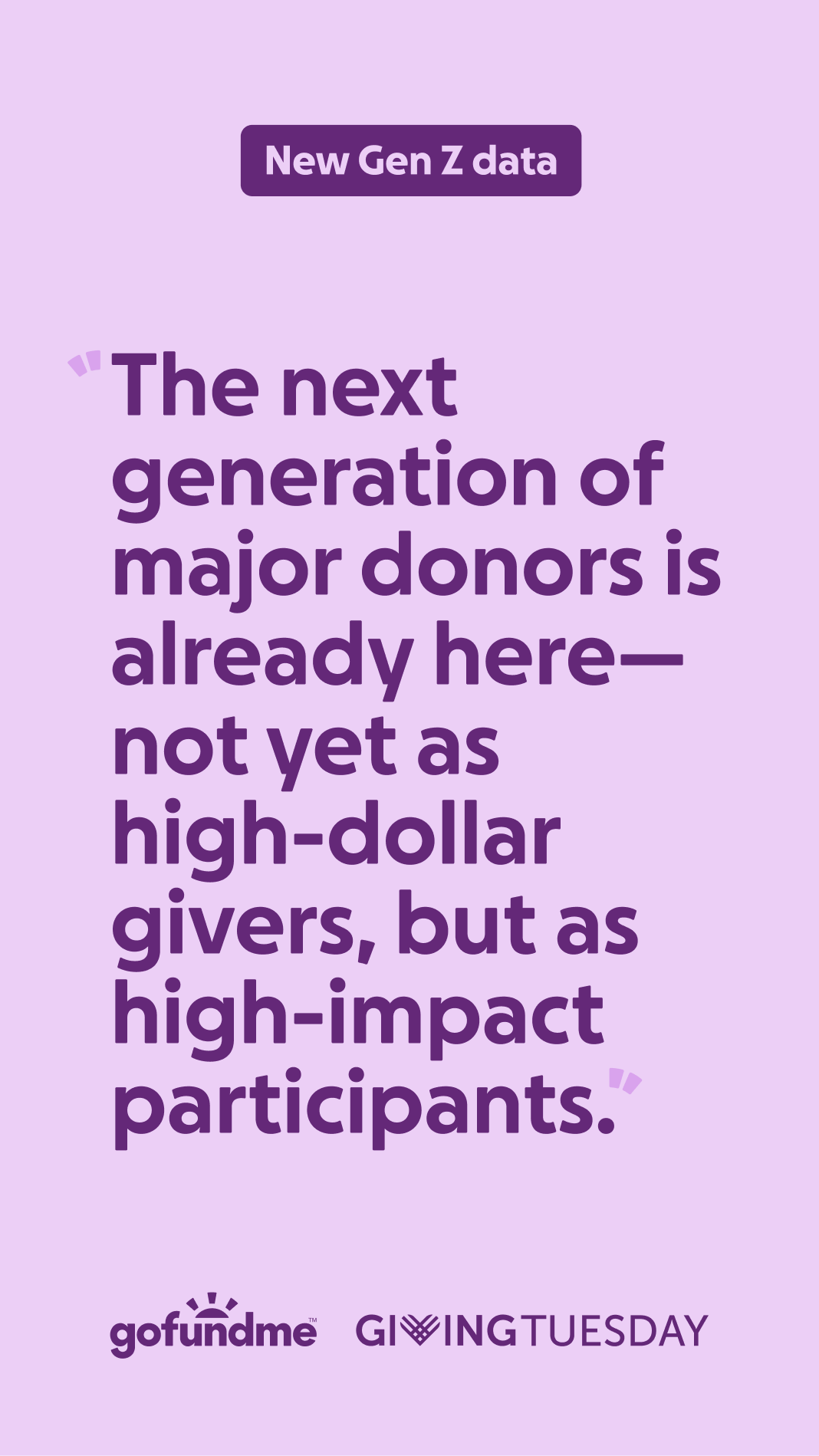
Ultimately, the next generation of major donors is already here—
not yet as high-dollar givers, but as high-impact participants.

The organizations that succeed will understand it’s not just about capturing immediate dollars, but about activating the networks that generate them over time.

💚

Share like Gen Z

Want more
insights like this?

Subscribe to receive the latest resources, education, and data from GoFundMe and GivingTuesday.

Step inside Gen Z generosity

Uncover the behaviors, values, and expectations shaping the future of fundraising.